
Quick Answer
If you’ve ever stared at a finished candle, a hand-stitched bag, or a resin coaster and thought, “okay… now what do I actually charge for this?”, you’re not alone. Pricing is the part of running a handmade business that almost nobody teaches you, and it’s the part that quietly decides whether your craft turns into a real income or stays an expensive hobby.
Here’s the short version: your price should cover your materials, your time, your overhead, and your marketplace fees, and then leave you a genuine profit on top. The formula looks like this:
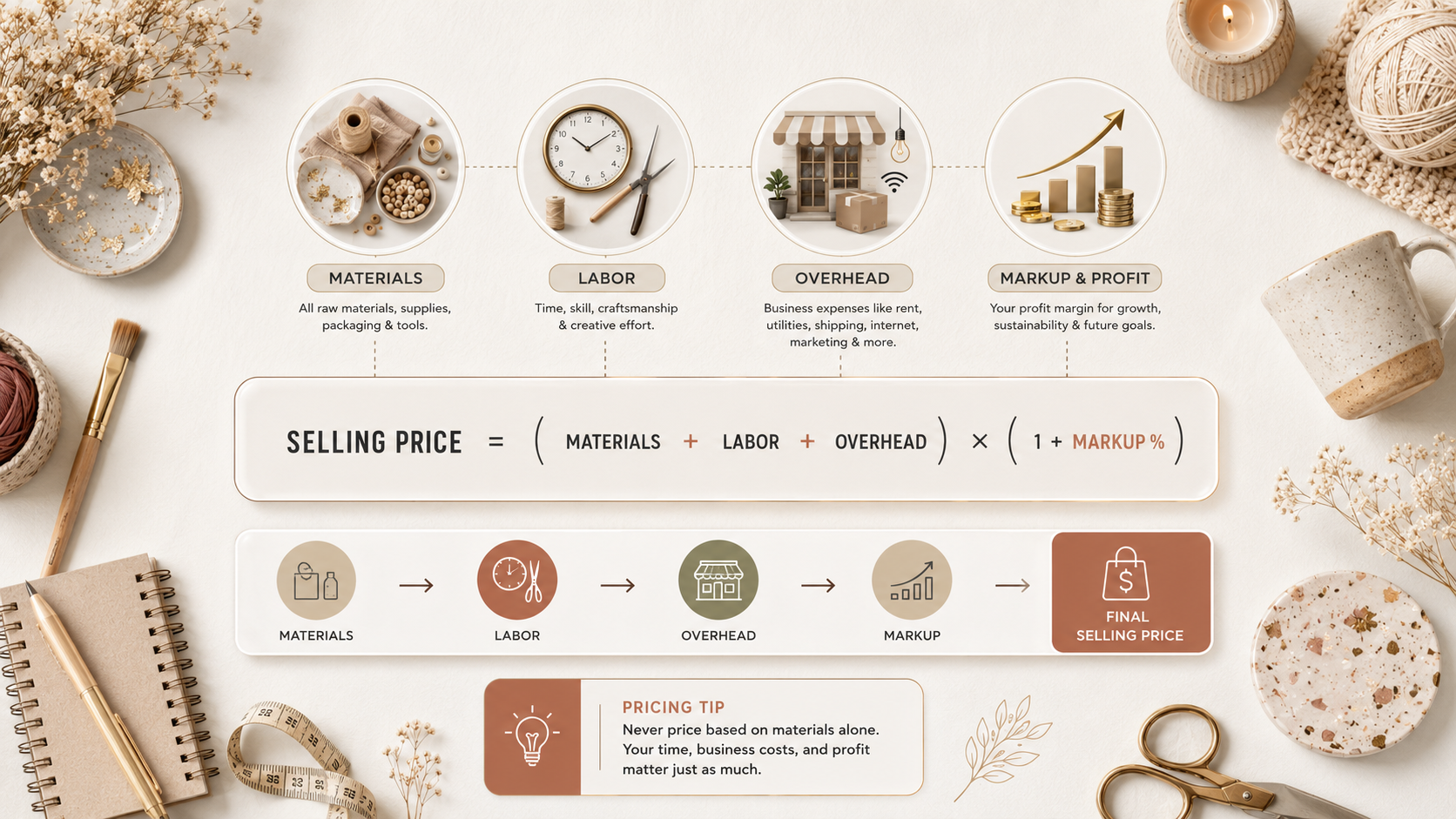
Selling Price = (Materials + Labor + Overhead) × (1 + Markup %)
That’s the starting point. The rest of this guide walks through exactly how to fill in each part of that formula, how UAE-specific costs like VAT and marketplace fees change the math, and how to price real products, from candles to jewelry to resin art, with numbers you can actually use today.
Why Getting Your Pricing Right Actually Matters
Underpricing feels harmless at first. You sell out at every market, your Instagram DMs are full of orders, and it seems like proof that your prices are working. In reality, it’s often proof of the opposite. If you’re constantly busy but never seem to have money left over after restocking supplies, your price isn’t reflecting the true cost of your work.
On the other end, overpricing without a clear reason (no story, no positioning, no market context) can push buyers toward competitors just as fast. The goal isn’t the highest price or the lowest price. It’s the right price: one that covers everything it costs you to make and sell the product, and rewards you fairly for your time and skill.
Understanding What Your Product Actually Costs You
Before you can price anything, you need an honest number for what it costs to make one unit. Most sellers underestimate this because they only count the obvious ingredient or material cost and forget everything else.
1. Materials
This is every physical component that goes into the finished product, not just the “main” material. For a candle, that’s wax, fragrance oil, wick, and the jar, but it’s also the label, the box, and the tissue paper it ships in. Packaging gets forgotten constantly, and it adds up faster than most makers expect.
2. Labor
Time is not free, even when it’s your own. Decide on a fair hourly rate for yourself first, whether that’s what you’d pay someone else to do the work, or simply a rate that reflects your skill level. Then time how long a product actually takes from start to finish, including prep and cleanup, not just the “fun” hands-on part.
3. Overhead
Overhead is everything that keeps your business running but isn’t tied to one specific product: electricity, your workspace, software subscriptions, marketing, equipment maintenance, and business licensing costs. Spread these across the number of units you expect to sell in a given period to get a per-unit overhead figure.
4. Marketplace or Platform Fees
If you sell on Crafty.ae, Etsy, or any other platform, a percentage of every sale goes to fees. If you sell at a market or fair, that’s a booth fee instead. Either way, this cost needs to be built into your price, not subtracted from your profit after the fact.
| Cost Component | What It Includes | Common Mistake |
|---|---|---|
| Materials | Raw ingredients, packaging, labels, shipping supplies | Only counting the “main” material and forgetting packaging |
| Labor | Making time, prep, cleanup, design time | Not paying yourself an hourly rate at all |
| Overhead | Rent, utilities, software, equipment, marketing | Ignoring it completely or lumping it into “materials” |
| Platform/Selling Fees | Marketplace commission, payment processing, booth fees | Forgetting to build fees into the price upfront |
The Core Pricing Formula
Once you know your true cost per unit, you apply a markup to arrive at your selling price:
Selling Price = Total Cost × (1 + Markup %)
A 100% markup simply means doubling your cost. If a product costs you AED 20 to make, a 100% markup brings you to AED 40.
Here’s where a lot of pricing advice gets confusing: markup and profit margin are related, but they are not interchangeable, and using them as if they mean the same thing is one of the biggest reasons handmade sellers end up unsure whether they’re actually profitable.
- Markup is the percentage added on top of your cost.
- Profit margin is the percentage of your final selling price that is actual profit.
A 100% markup does not give you a 100% margin. It gives you a 50% margin, because half of your selling price is cost and half is profit. This distinction matters because most sellers benchmark against “profit margin” targets without realizing the markup number they need is actually higher.
| Markup % | Resulting Profit Margin |
|---|---|
| 50% | 33% |
| 100% | 50% |
| 150% | 60% |
| 200% | 67% |
For most handmade retail products, a 100–200% markup (50–67% profit margin) is a reasonable range before fees. After accounting for platform fees and overhead, most sellers land on a net profit margin of 20–40%, which is generally considered healthy for a small handmade business. If your margin is consistently below 20%, it’s usually a sign that labor isn’t being properly priced in, or that fees are quietly eating your profit.
Also Read: Craft Trends 2026 In The UAE
Pricing Factors Specific to Selling in the UAE
Generic pricing advice online is almost always written with US dollars and Etsy’s fee structure in mind. Selling in the UAE comes with its own set of costs and rules that deserve direct attention.
VAT Registration Thresholds
Once your handmade business’s taxable turnover crosses a certain level, VAT registration with the Federal Tax Authority becomes mandatory, and you’ll need to start charging VAT on your sales. Below that mandatory level, there’s usually a lower threshold at which registration becomes optional rather than required, and below that, most small or hobby-turned-business sellers are exempt altogether. These thresholds and rates are set and periodically updated by the Federal Tax Authority, so rather than relying on a fixed number, it’s worth checking the current official guidance directly on the FTA’s website, or speaking with a tax advisor, as you start approaching meaningful revenue. It’s still worth tracking your turnover from early on so you’re not caught off guard as your business grows.
Marketplace and Selling Channel Costs
Every selling channel has a different cost structure, and your price needs to account for whichever one you’re using.
| Selling Channel | Typical Cost to You | Notes |
|---|---|---|
| Crafty.ae marketplace | Commission per sale, no upfront listing fees | Built for UAE-based handmade sellers, with local buyer trust already established |
| Instagram / WhatsApp direct sales | Payment processing fees only | Lower fees, but you handle marketing and customer service yourself |
| Craft fairs and pop-ups (e.g. Ripe Market, ARTE, Sikka Art Festival) | Booth or table fee, sometimes a sales commission | Great for direct feedback and premium, in-person pricing |
| Wholesale to boutiques or gift shops | Lower per-unit price, higher volume | Requires a separate wholesale pricing calculation, generally 2x cost minimum |
Your cost per product doesn’t change depending on where you sell it, but the fees layered on top do, which is why the same candle might reasonably be priced slightly differently on Crafty versus at a weekend market stall.

Worked Pricing Examples for Popular Handmade Products
Numbers make pricing click in a way formulas alone don’t, but exact costs vary so much by supplier, location, and season that fixed figures can be misleading rather than helpful. Below is how the formula plays out for common handmade categories, category by category, so you can plug in your own real costs rather than someone else’s.
Soy Candles
Materials means wax, fragrance oil, wick, jar, and label, added together in order to make handmade candles UAE. Labor means your actual making time, typically a short, fairly quick process per unit, at your chosen hourly rate. Overhead means a small allocation for utilities, packaging, and workspace costs. Add these together for your total cost, then apply your chosen markup. Candles are usually priced in the moderate range for markup since materials are relatively low-cost relative to the finished product’s perceived value, and rounding to a clean, confident price point tends to work well for this category.
Resin Art
Materials used for making these handmade art products; resin, pigment, mold usage, and packaging. Labor means resin work often involves curing time as well as active hands-on time, so factor in the total project timeline, not just the active minutes. Overhead means a modest allocation for equipment wear and workspace. Total these up and apply your markup. Because resin pieces are often visually distinctive and harder to replicate quickly, they can generally support a healthy markup once your true cost is accounted for.
Handmade Crochet Items
Crochet Items, such as a tote bag. Materials means yarn and any embellishments or hardware. Labor means crochet is highly labor-intensive relative to material cost, so the hours involved should be tracked carefully and valued fairly, since this is usually the single largest cost component. Overhead means a smaller allocation relative to labor. Because labor already makes up most of the cost here, a lower percentage markup on top of your total cost can still result in a fair, sustainable price, since the labor cost has already built in most of your reward for time.
Sterling Silver Jewelry
Products such as a simple pendant. Materials means silver, chain, findings, and packaging. Labor means often a shorter production time, but priced at a higher hourly rate to reflect the specialized skill involved. Overhead means a small allocation for tools and workspace. Jewelry products tends to support a strong markup once materials, skilled labor, and overhead are combined, particularly for pieces with a distinctive design or premium materials.
Handmade Pottery
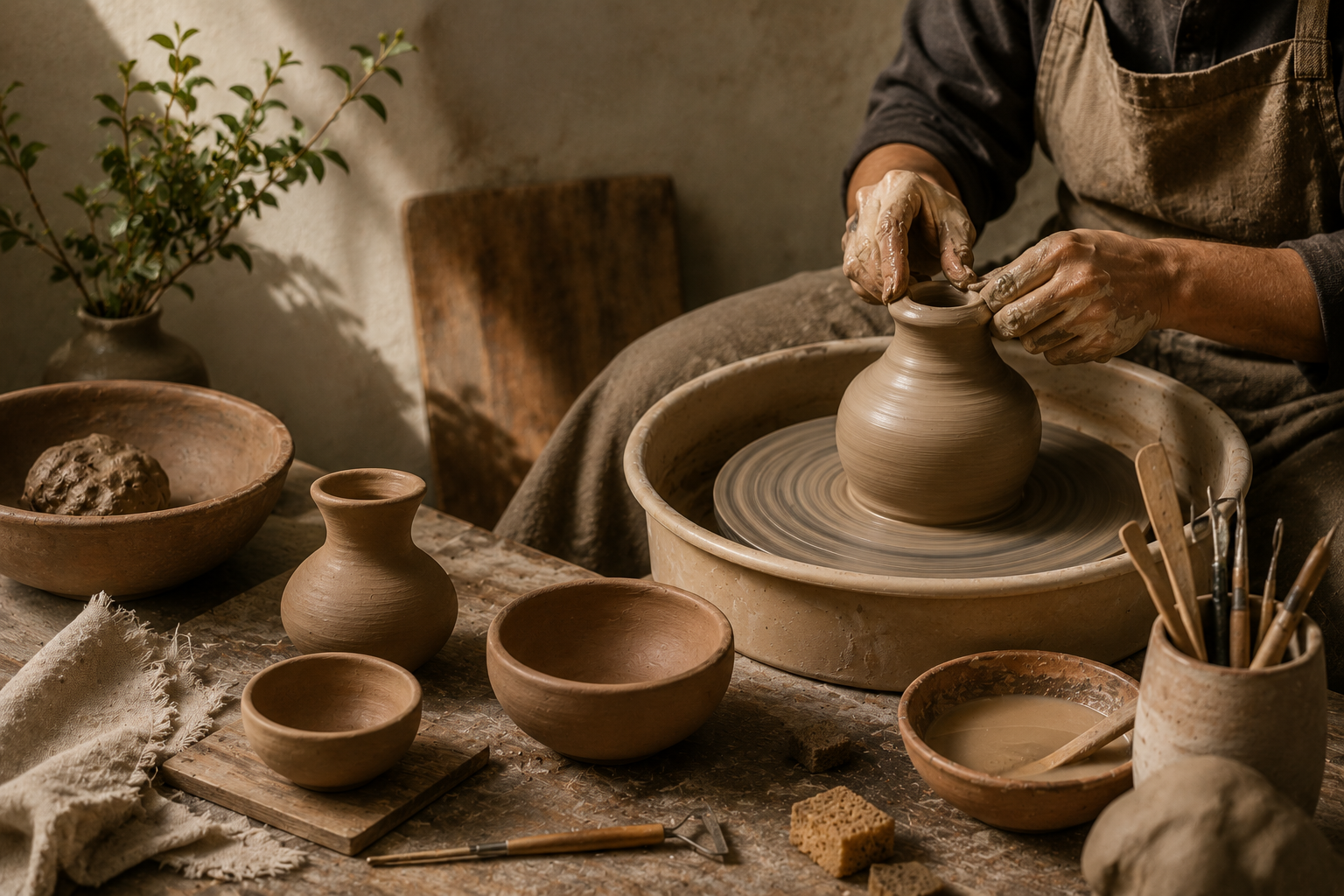
Materials used in pottery such as clay, glaze, and firing costs. Labor means hands-on shaping and finishing time, plus an allocation for kiln or studio overhead, which is often higher for pottery than for other categories. Overhead means kiln electricity and equipment wear should be factored in specifically, since these are recurring, real costs many potters underestimate. Once materials, labor, and the higher overhead typical of pottery are combined, a solid markup on top still generally keeps pricing competitive and profitable.
As a next step, it’s worth building a simple spreadsheet or using a pricing calculator with your own real material costs, your own hourly rate, and your own overhead figures, so the numbers reflect your actual business rather than an estimate.
Choosing Your Pricing Method: Cost-Based vs. Value-Based
Not every product should be priced the same way, and this is where a lot of pricing guides give overly rigid advice.
Cost-based pricing (the formula above) works well for products where materials and time are the main value driver: candles, soap, everyday jewelry, home décor with straightforward production. It’s reliable and protects you from underpricing.
Value-based pricing works better for one-of-a-kind or highly skilled pieces: original paintings, custom commissioned jewelry, intricate embroidery, or culturally significant designs like Arabic calligraphy art or oud-scented products with premium sourcing. Here, the price reflects the uniqueness, story, and skill involved, not just the materials and hours. A painting that took four hours to complete but represents years of developed skill is not “worth” four hours of minimum wage. It’s worth what a buyer who values that skill is willing to pay.
There’s no universal right answer between the two. The trade-off is this: cost-based pricing is safer and easier to defend, while value-based pricing has higher upside but requires stronger branding, storytelling, and market positioning to justify.
Pricing Psychology: How Buyers Actually Perceive Your Price
Price isn’t only a number that covers costs. It also signals quality. A candle priced noticeably lower than every other handmade candle around it doesn’t read as “a better deal.” It often reads as lower quality, or not truly handmade at all.
A few practical points worth applying:
- Round, confident pricing (AED 100, AED 150) tends to suit premium handmade products.
- Prices ending just under a round number (AED 95, AED 149) can feel more approachable for everyday, lower-cost items.
- Bundling complementary products (a candle and a matching wax melt, gift items, or a pendant and matching earrings) increases perceived value more effectively than a straight discount.
- Bulk discounts like “buy 2, get 1 free” tend to feel more generous to buyers than a flat percentage off, even when the actual saving is similar.
Repricing Existing Products Without Losing Customers
If you’ve realized your current prices are too low, raising them can feel risky, but keeping them where they are is riskier for your business long-term. A few ways to do it without alienating your existing buyers:
- Introduce the new pricing with upcoming products or restocks rather than changing everything overnight.
- If you have repeat customers, a short, honest note (rising material costs, more detailed craftsmanship, updated packaging) goes a long way. People generally respect transparency far more than silence.
- Watch your demand signals before raising prices: if products sell out within hours consistently, or you have a waitlist, that’s a strong indicator you have room to increase your price without losing sales.
- Small, gradual increases are easier for both you and your customers to absorb than one large jump.
Common Handmade Pricing Mistakes to Avoid
| Mistake | Why It Hurts Your Business |
|---|---|
| Pricing based only on material cost | Ignores your time entirely, the single biggest hidden cost in handmade products |
| Copying competitor prices directly | You don’t know their cost structure, and they may be underpricing too |
| Forgetting packaging and shipping supplies | These are real, recurring costs that quietly shrink your margin |
| Not adjusting prices as material costs rise | Locks you into shrinking margins over time |
| Charging the same price across every channel without adjusting for fees | Wholesale, marketplace, and direct sales all carry different cost structures |
| Never revisiting your pricing after the first calculation | Your costs, skill level, and demand all change; your pricing should evolve with them |
Your Handmade Pricing Checklist
- [ ] Calculate total material cost, including packaging
- [ ] Set a fair hourly labor rate and time your production process honestly
- [ ] Allocate a realistic overhead cost per unit
- [ ] Decide between cost-based or value-based pricing for this specific product
- [ ] Apply your markup and check the resulting profit margin
- [ ] Add in the fees for your specific selling channel (Crafty.ae, market stall, wholesale)
- [ ] Compare your final price against the value and positioning of your product, not just competitors
- [ ] Revisit this checklist every few months, or whenever material costs change
Frequently Asked Questions
If you’re ready to put these numbers into practice, Crafty gives you a UAE-based marketplace built specifically for handmade creators, with buyers who are already looking for original, locally made products. If you’re still deciding where and how to sell, our guide on starting a handmade business in the UAE and our breakdown of the best UAE marketplaces for handmade sellers are good next steps.